
If your fundraising appeals aren’t moving donors to give—if they’re inspiring warm feelings but not actual gifts—you’re probably missing one of three critical elements in your case for support.
Most nonprofits follow the standard advice: tell compelling stories, make it emotional, and show the need. And still, donors read the appeal, feel moved, and… don’t give.
After helping our clients collectively raise over a billion dollars in capital campaigns and annual appeals—from Save the Redwoods League’s $139M campaign to the Rhodes Trust’s £200M effort—we’ve identified what separates fundraising messages that inspire from messages that actually move people to give.
The answer: you need urgency (why now), emotion (why care), and rationale (why it makes sense). All three must work together in the right balance.
The Problem: Most Fundraising Appeals Only Hit One Element
For years, best practices have swung between extremes. All urgency-focused fundraising campaigns create crisis fatigue. All emotion-focused fundraising campaigns may feel manipulative.
All-rationale fundraising campaigns—especially data-heavy ones—rarely inspire donors to act. Across the country, this is the most common mistake we see in campaign cases: We need the money. Here’s how we’ll spend it.
That approach centers the organization and sidelines the donor. And when donors can’t see themselves in the story—when they’re not invited into something bigger than a transaction—it’s almost never enough to spark the kind of energy and generosity that fuels a successful campaign.
Think of it like a Venn diagram—urgency in one circle, emotion in another, rationale in the third. Where do these three overlap? That’s where an irresistible case for support lives.
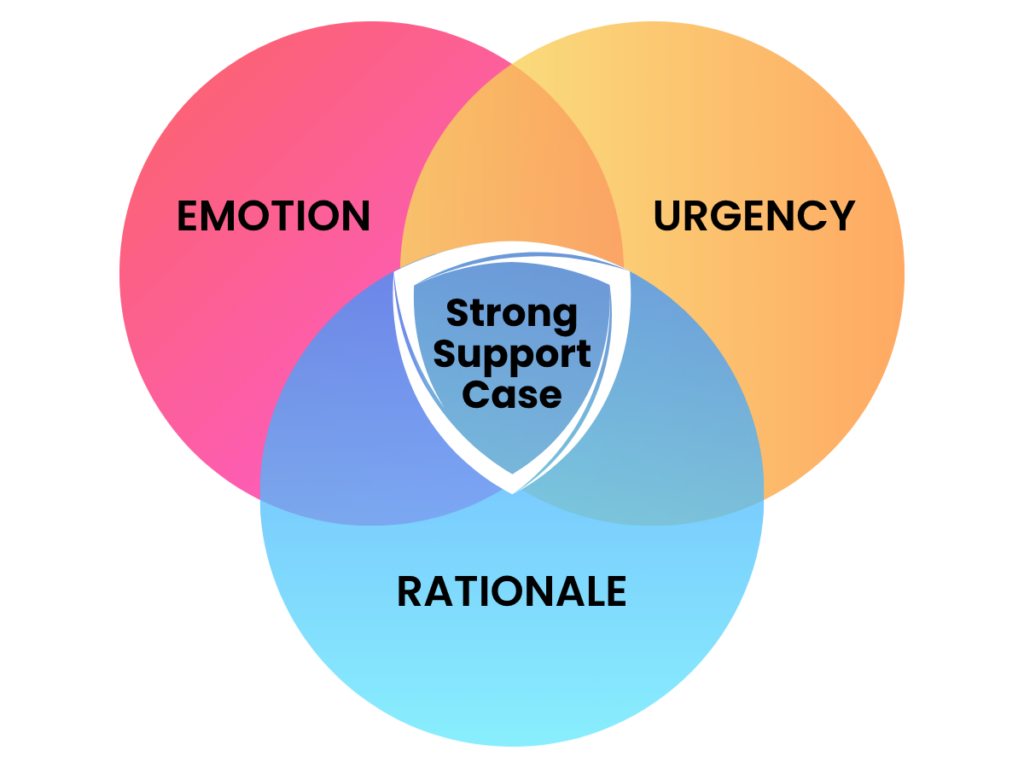
We wrote about this exact formula in last year’s Advancing Philanthropy magazine, published by Association of Fundraising Professionals, and we wanted to dig deeper here on how to actually apply it—whether you’re building a capital campaign case, writing an annual appeal, or preparing for major donor conversations.
How to Create Urgency in Fundraising (Without Fake Deadlines)
The mistake: Arbitrary deadlines donors didn’t ask for. (“Give by midnight to help us meet our quarterly goal!”)
What works: Real, timely reasons that connect to something bigger than your organization.
Real urgency might look like:
- A once-in-a-generation opportunity to acquire land or real estate
- A challenge grant that actually doubles gifts
- A scientific breakthrough that makes environmental restoration possible
- A turning point where action now versus later determines outcomes
Save the Redwoods League framed their $120M campaign around scientific urgency: for the first time, we had the tools to not just protect forests, but restore what had been lost. “By acting now, we could forever restore and protect the redwood forests of California.” The campaign raised $139M.
The University of British Columbia used a different frame for their $300M campaign: “We’re at a turning point where we must work collaboratively or submit to a status quo of waning impact. But if it doesn’t happen now, it will happen too late.” The campaign is on track to exceed its goal.
Exercise: Find Your Real Urgency
Answer these questions 10 times each:
“If we don’t reach our goal, then __________ will happen.”
“If we do reach our goal, then __________ will happen.”
Your first answers will likely focus on features like “We’ll get the new building”. By response five or six, you’ll start to name benefits: “We’ll create space for collaboration that solves pressing problems”. That’s what donors respond to. Don’t just look at this exercise. Do it. You’ll be amazed by what you uncover.
How to Create Emotional Connection with Donors
The mistake: Thinking emotion only comes from showing suffering.
What works: Tapping into emotions donors want to feel—pride, hope, connection, legacy.
Donors give because it connects to something they already care about.
Start with Donor Values, Not Demographics
When we worked with the Rhodes Trust at Oxford University on their global campaign, we didn’t create 100 personas based on demographics. We asked: What values unite these audiences?
We identified five: Personal Prestige, National Pride, Single-Issue Focus, Future Motivation, and Pride of Association. Then we connected the campaign strategy and creative to those values. The result? A £200M campaign on pace to exceed its goal, uniting donors across race, class, and geography.
San Francisco University High School leaned into pride in their $65M campaign. Their Director of Strategic Philanthropy captured it: “Every time I see this campaign brochure, I think about the pride I feel in sharing it with a donor prospect. It’s absolutely beautiful.” The campaign exceeded its goal, and students for generations to come will benefit.
How to Build Donor Confidence with Strategic Rationale
The mistake: Thinking “we need the money” is a rationale.
What works: Clear logic that explains why THIS campaign makes strategic sense, and why the donor can trust you with their investment.
Strong rationale might include:
- Track record of previous campaign success
- Data showing institutional need compared to peers
- Scientific breakthroughs that make impact achievable
- Bold strategic plan inspiration because of its vision and readiness to execute
- Leadership that has proven they can take on big challenges
The Los Angeles LGBT Center used track record: “We previously completed a capital campaign of a similar size that resulted in significant benefits. You can count on us to succeed again.” They raised the $20 million to buy the building and expand their impact.
Georgetown Preparatory School combined emotional storytelling with hard data for their $60M campaign—the largest in the school’s 200-year history. They tapped the values of the school and its graduates to reinforce the need for a generous scholarship program alongside data revealing how far lagging they were behind peer schools. That strategic use of comparative data gave donors the rational confidence to make transformative gifts. The campaign exceeded its goal.
Save the Redwoods League combined emotional appeal (majesty of forests) with scientific rationale (permanent protection is now achievable). The rational case gave donors confidence to give at unprecedented levels.
Stanford Humanities Center used the rationale that the best universities ensure that their students and faculty have diverse learning opportunities and access to a rich intellectual campus life. This rationale, matched with the right mix of urgency and emotion, resulted in them securing the largest gift in their history.
How to Apply This Formula to Your Fundraising
This approach works across all donor communications:
- Capital and endowment campaign cases: Balance emotional stories with proof of concept and timely opportunity
- Annual fund appeals: Show what’s possible now, why it matters to donor values, and why your approach works
- Annual reports: Demonstrate urgency of what’s next, emotional impact of last year, and strategic rationale for continued support
- Major donor conversations: Lead with what they value (emotion), give them confidence (rationale), then show why the gift is needed now.
Whether you’re raising $50K through email appeals or $500M in a multi-year capital campaign, this formula proves itself across sectors and scales.
Start Here: Audit Your Current Materials
Pick your next appeal, campaign case, or donor presentation and ask:
- Do I have real urgency? (Not a fake deadline—a genuine “why now”)
- Do I tap into emotions donors want to feel? (Pride, hope, connection, legacy)
- Do I give donors solid rationale for being confident? (Strategic logic that makes sense)
If you’re missing any of the three, that’s your starting point.
Frequently Asked Questions (FAQ) About Compelling Fundraising Appeals
Q: How do you create urgency without being pushy?
Focus on real inflection points—scientific breakthroughs, once-in-a-generation opportunities, strategic milestones—not arbitrary fundraising deadlines. Authentic urgency comes from genuine “why now” moments that matter to donors, not countdown timers. Donors know the difference. Tell the truth.
Q: What’s the difference between a compelling story and a compelling case for support?
A compelling story evokes emotion. A compelling case for support combines that emotion with urgency (why act now) and rationale (why this approach works). Stories are one essential element of a strong case, not the whole thing.
Q: Should you customize your case for different donor audiences?
Customize your emphasis, not your core message. All donors need urgency, emotion, and rationale—but a legacy donor might respond more to “this secures our future for generations” while a first-time major donor might need more proof of impact. Keep the foundation consistent; adjust the framing.
Q: How do you identify what donors value?
Interview a cross-section of donors and listen for patterns—not what they say they value, but what their giving history and life choices reveal. Do they prize legacy? Innovation? Justice? Community impact? Do they see themselves as titans? Humble servants? Changemakers? Group donors by shared values, not demographics.
Q: How long should a case for support be?
The better question is: what format will move your specific donors? Most successful campaigns use multiple touchpoints: a video for emotional connection, a brochure for the detailed case, presentation tools for one-on-one conversations, and a unifying campaign theme that ties it all together.
We’ve seen campaigns succeed with 4-minute videos that capture urgency and emotion more powerfully than any written case. Others need an 8-page brochure that tells the complete story. Major donors often respond best to live conversations backed by a compelling presentation deck. The format matters less than whether it delivers all three elements—urgency, emotion, and rationale—in a way that resonates with your audience.
Q: How do we know if we need outside help to develop campaign communications?
If your campaign goal is ambitious, if you’re trying to attract transformational gifts, or if your messaging hasn’t been tested with donors, professional campaign communications typically pay for themselves in the first new gift. We developed a 6-question framework for assessing campaign readiness—including when to bring in strategic partners and how to get your bhow to get your board on board with investing in communications. It walks through what makes campaigns exceed their goals.
What’s Next?
Want to see this formula applied to annual reports? We’re hosting a free webinar on April 29—Turn Your Annual Report into a Compelling Fundraising Asset—where we’ll demonstrate how to use urgency, emotion, and rationale to transform your annual report into a fundraising tool. Register here.
Ready for help with your campaign or appeal? We’ve helped clients raise millions by getting the formula right—not through gimmicks, but through strategic donor communications that move people. Let’s talk.
You’re doing important work. Let’s make sure your fundraising does it justice.

Mission Minded helps nonprofits, foundations, and schools build unapologetically bold brands, strategies, and campaigns that stand out and get results.
In 20+ years, we’ve helped clients raise millions, grow their reach, and deepen their impact. No tepid ideas. No cookie-cutter solutions. Just powerful strategy and creativity that actually moves people. Let’s talk.
Curious what we could do together?