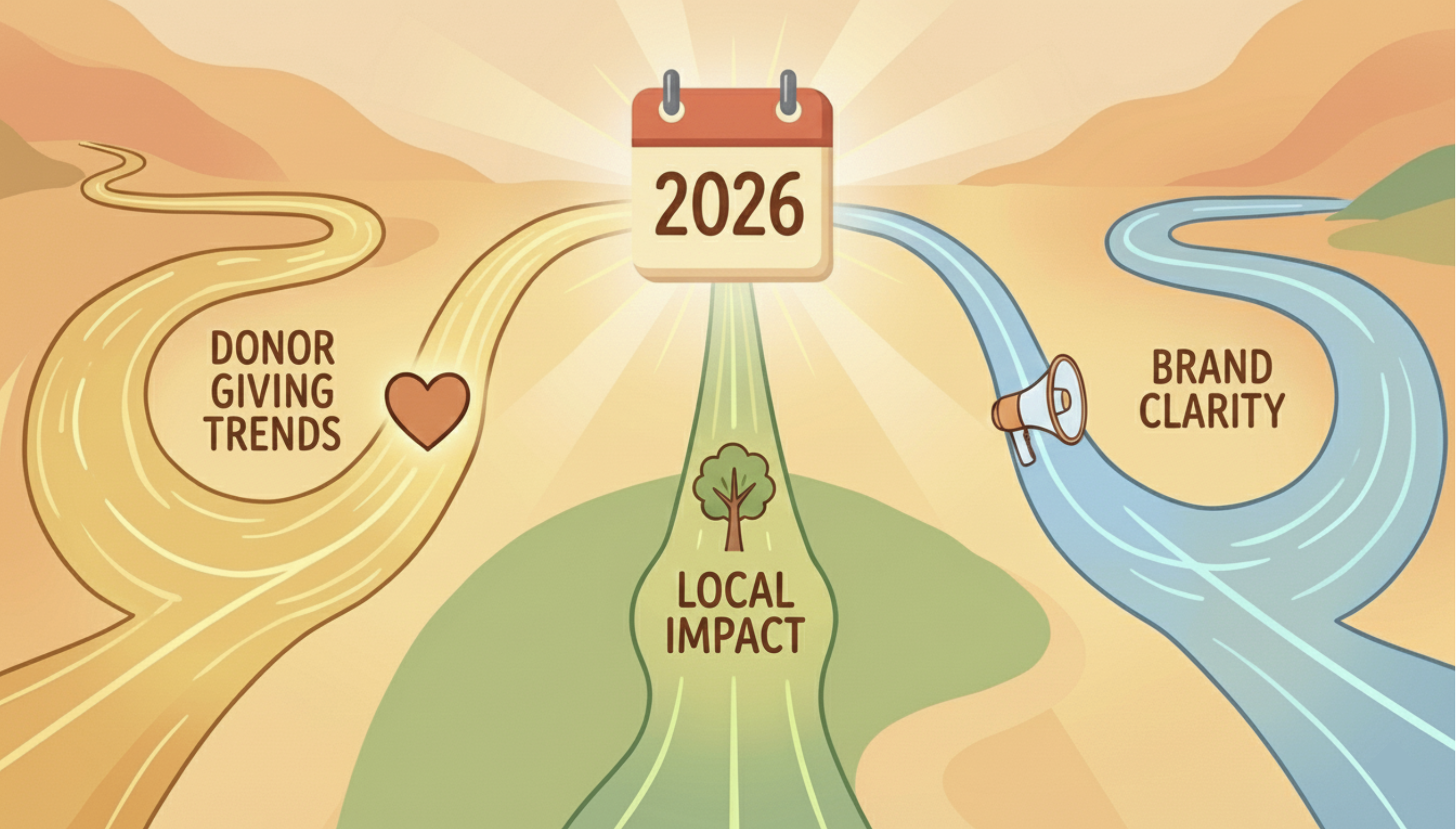

The Landscape Nonprofits Must Navigate in 2026
The nonprofits that thrive in 2026 won’t be the ones with the biggest budgets or the most staff. They’ll be the ones with the clearest answer to one question: Why should I give to you instead of the dozen other organizations doing similar work?
That’s not a hypothetical. It’s the question donors are asking right now—whether they say it out loud or not.
The Chronicle of Philanthropy has identified what many of us have been living: a triple economic threat of inflation driving up expenses, pandemic relief funds evaporating, and donations falling. That storm hasn’t passed. And the organizations that make it through aren’t the ones waiting for stability to return. They’re the ones getting clearer, faster, and bolder.
One of our clients, Ashley Costa, Executive Director of Lompoc Community Health Care Organizations, put it starkly: “I think some organizations are going to live or die based on their ability to adapt to the constantly changing environment.”
As Ashley emphasized, “You need option A, B, and C right now.”
But even in crisis, there are opportunities. “There are silver linings to these moments,” she said, pointing to how telemedicine grew exponentially during COVID—something that wouldn’t have happened otherwise.
Across the Sector, the Same Patterns Keep Emerging
We know every nonprofit is navigating its own mix of challenges. Some are managing federal funding uncertainty. Others are rebuilding donor pipelines or rethinking programs. Community health organizations are stretched thin. Arts nonprofits are competing for shrinking discretionary dollars. Advocacy groups are navigating a shifting political landscape. Foundations are asking harder questions about impact.
But across all this diversity, the same forces keep surfacing in our conversations with leaders: the donor pool is shrinking and getting pickier, local impact is becoming the differentiator, and brand clarity is no longer optional.
Here’s what we’re seeing—and how forward-thinking leaders are responding.
TREND 1: The Donor Pool Is Shrinking—But Those Who Give Are Giving More
Here’s the core shift: the donor pool is smaller, pickier, and more values-driven than ever.
Reports from GivingTuesday paint a clear picture: fewer people are donating overall, but those who give are giving more. You’re competing for a smaller pool of donors who can afford to be choosier.
WHY THIS MATTERS
Tara Peterson, Executive Director of the Center for Domestic Peace, is seeing this firsthand: “People are being a lot more selective about where they give their money. They want to see impact. They want to know exactly what their dollars are doing.”
National research shows donor retention rates hover around 55-60%. That means many organizations are losing nearly half their donors every year—and each lost donor hurts exponentially more because they’re harder to replace.
As Tara put it: “If people trust you, they’re more likely to give. And if they don’t know who you are or what you stand for, they’re not going to take that risk.”
And here’s what many organizations get wrong about major donors: they treat them as fundamentally different from everyone else. Stop that. Major donors share the same values as all your donors—they just have greater capacity to give. And increasingly, donors at all levels want more than a transactional relationship.
Tara sees this shift: “We’re seeing more people who want to be involved beyond just writing a check…they want to feel connected to the work…People want to feel like they’re part of something, not just a donor.”
WHAT‘S WORKING?
Organizations that are thriving right now are prioritizing retention as much as acquisition. They’re treating major donors as people with shared values. And they’re investing in brand clarity so donors immediately understand who they are and why they matter.
They’re also telling stories that create connection—not program descriptions or impact reports. Stories that make people feel something. Stories that make them want to be part of what you’re building.
HERE’S WHAT YOU CAN TRY
Retention isn’t just good stewardship—it’s your survival strategy. Start by auditing your donor communications: Are you treating donors like partners? Is your impact clear and specific? Do your thank-you messages make people feel like they’re part of something meaningful?
Strong retention requires a strong, clear, consistent brand. If donors don’t know who you are or what you stand for, they won’t take the risk. But if they trust you? They’ll stay—and they’ll give more.
TREND 2: Local Impact Is Your Untapped Advantage
When people feel powerless at the national level, they double down on local impact. This is especially true right now.
WHY THIS MATTERS
Ashley sees this clearly: “I think people feel like they can’t make a difference nationally or even statewide. I think if you can focus on the place-based, the community, that’s really gonna be the sector’s ticket to survival.”
Even global issues land differently when told through local stories. As Ashley put it: “Even if it’s a global or national issue impacting your community, tell the story from your community, about a person, a family, or institution.”
WHAT‘S WORKING?
The clearest organizations are making their local impact impossible to miss. They’re leading with community-level stories, not national statistics. They’re showing donors exactly how their dollars create change right here—not somewhere abstract.
If you’re local, make your impact crystal clear. If you’re national, show how donations create change in specific communities, with specific people.
HERE’S WHAT YOU CAN TRY
Look at your website, your donor letters, your social media. How quickly can someone understand where and how you make a difference? Can they see themselves—or their community—in your story?
In a noisy, overwhelming moment, “local” cuts through. It’s tangible. It’s trustworthy. It’s something donors can see and feel. The organizations that own their local story will have a real advantage in 2026.
TREND 3: Brand Clarity Is No Longer Optional—It’s Survival
There’s so much noise out there. And if you can’t cut through it, you’ll get lost.
WHY THIS MATTERS
Ashley nailed it: “It’s only getting harder to know what and who to believe. And I think having a strong brand becomes critical because people, if they trust you and know you, they know that they can believe you.”
Tara agrees: “There’s so much noise out there right now, and if you can’t cut through that noise and tell people why they should care about your organization, you’re going to get lost.”
According to the Communications Network’s 2025 Pulse Poll, 24% of organizations reaffirmed their commitment to core mission. That’s smart—but it’s only half the battle. You also need to communicate that mission in a way that’s clear, consistent, and unmistakably you.
Your brand must answer these questions with authentic, human language—not nonprofit jargon. Trust is currency in times of uncertainty.
WHAT‘S WORKING?
The organizations standing out aren’t using clever taglines. They’re using straightforward language that a 12-year-old could understand. Their brand positioning isn’t their mission statement—it’s their answer to “Why you, why now?”
They’re building consistency across every touchpoint: website, social media, donor letters, events. Because inconsistency makes you look disorganized, even when you’re running a tight operation.
And they’re treating their website as their primary brand experience. Brand, after all, is a promise of a future interaction. You’re saying, “This is what you can expect when you engage with us.” If someone lands on your homepage and has to click three times to figure out who you are and what you do, you’ve lost them.
HERE’S WHAT YOU CAN TRY
Ask yourself: Can you clearly answer “Why us, why now?” If you struggle to articulate it, so will your donors.
Make your brand immediate, clear, and compelling. That’s what will carry you through uncertainty.
What Else We’re Hearing
Beyond the three big trends, two other themes keep coming up in our conversations with leaders:
Use AI Wisely
Over 60% of nonprofits are now using AI tools. By 2026, expect that to hit 80-90%. The question isn’t whether to use AI—it’s how to use it without losing what makes you unique.
Ashley raised a critical point: “It’s like everyone’s kind of looking the same, too…how can you continue to set yourself apart, even if you do use AI? Don’t just copy and paste, because everyone knows it’s from AI with the bolding and the em-dashes.”
AI-generated content has a sameness to it. If you’re not infusing it with your unique voice and stories, you’re just adding to the noise.
Put this into practice: Use AI as a starting point, not an endpoint. Let it help with first drafts, research, or brainstorming—but always layer in your own voice, your own stories, and your own perspective. Organizations that resist AI entirely will fall behind. Organizations that over-rely on it will lose the human touch. Find the balance.
Collaborate, Don’t Just Compete
Research shows 73% of nonprofits that collaborated—through mergers, shared programs, or joint initiatives—achieved measurable success. More services, more funding, better outcomes.
In 2026, ask “Who can we partner with?” instead of “Who are we competing against?”
Two things make partnerships work: First, clarity about your own brand. When you know what you stand for, you’re a better partner. Second, your partnership needs its own brand. Who are you when you work together? How should the collaborative be perceived?
What could you accomplish together—shared administrative functions, co-developed programs, amplified messages? The sector gets stronger when we collaborate more and compete less.
What This Means for 2026
As Ashley said, organizations will “live or die based on their ability to adapt.” But adaptation isn’t just about surviving—it’s about finding silver linings and building a brand so strong that people trust you through uncertainty.
The nonprofits thriving in 2026 will be the ones that:
- Build diverse revenue streams before crisis hit, because federal funding is more uncertain than ever and individual giving is concentrated among fewer donors
- Invest in brand clarity now, while they had time to get it right, because with so much noise, you can’t afford to be vague about who you are and why you matter
- Prioritize donor retention as much as acquisition, because replacing lost donors is exponentially harder when the donor pool is shrinking
- Use technology thoughtfully without losing their humanity, because AI is ubiquitous now, but sameness is the enemy of differentiation
- Create authentic partnerships with aligned organizations, because collaboration is how you do more with less in an era of constraint
- Revisit your strategic plan with fresh eyes, because the plan you wrote before or during the pandemic may not reflect the world your donors and community live in today.
The Real Question
The question for 2026 isn’t “Can we survive this?” It’s “How can we come out stronger?”
Here’s a quick gut-check to help answer it:
- Can you clearly answer “Why you, why now?” If donors can’t immediately understand what makes you different, they’ll give elsewhere.
- Are you telling your local story? Even if your issue is national or global, donors want to see impact they can touch.
- Is your brand consistent across every touchpoint? Website, social, donor letters, events—does it all feel like the same organization?
Hard work alone won’t cut it. What wins now is strategic thinking, nimble adaptation, and crystal-clear communication about why you matter.
People need to trust you and know you—especially when everything else feels uncertain. That’s brand. That’s what will carry you through.
So here’s what we want to know: What’s your biggest concern heading into 2026? And more importantly—what’s your plan to address it?
Need a Thought Partner? Let’s Talk.
If any of this is resonating—whether you need help clarifying your brand, building a campaign that actually moves people, or creating donor communications that don’t sound like everyone else’s—we’re here to help. Let’s talk.
And if you’re not ready for a full project but just want to think out loud with someone who gets it, we save a few free office hours each month for exactly that. Just drop us a line at amplify@mission-minded.com.
This post draws on research from the Chronicle of Philanthropy, GivingTuesday, and the Communications Network, as well as insights from nonprofit leaders navigating these challenges in real time.

Mission Minded helps nonprofits, foundations, and schools build unapologetically bold brands, strategies, and campaigns that stand out and get results.
For more than 20 years, we’ve helped mission-driven organizations rally donors in moments of uncertainty, raise millions, and deepen their impact. No tepid ideas. No cookie-cutter solutions. Just powerful strategy and creativity that actually moves people.
If your nonprofit is navigating funding pressure, donor fatigue, or a brand that no longer reflects your impact, we’ll help you build the clarity and donor confidence you need for 2026 and beyond.