


In this article:
- How AI Has (Or Hasn’t) Changed Brand Discovery
- People Don’t Enter Your Marketing at the Top
- Think Exposure Loop, Not Marketing Funnel
- Your Website Has to Meet People Where They Are
- Rethink the Funnel and Rebuild Your Brand Experience
For years, marketers have pictured the user journey as a funnel: awareness at the top, consideration in the middle, conversion at the bottom. It’s a useful diagram. It’s also not how people behave.
For nonprofits, that journey has always been a little more complicated. A “conversion” might mean signing up for a program, attending an event, making a first gift—or simply deciding to learn more. And unlike a one-time purchase, many of those actions are the beginning of a much longer relationship. The funnel can still help us understand the path from awareness to action, but it was never meant to capture everything that happens before, between, and after those moments.
Someone might discover your organization through a social post, visit your website six weeks later, read an impact story, leave, hear about you from a friend, return through Google, sign up for an event, and eventually decide to make a major gift. Someone else may search your organization by name this morning because they’re ready to sign up or donate right now.
They’re both legitimate journeys. Your website needs to be ready for both. And with AI changing how people discover and evaluate organizations online, the old funnel is worth rethinking.
How AI Has (Or Hasn’t) Changed Brand Discovery
AI search is new. The impact on search behavior isn’t. For years, Google has been answering more questions directly on the search results page through featured snippets, knowledge panels, maps, images, local results, and other features that give people what they need without requiring a visit to a website. A 2026 study shows that nearly 68% of U.S. Google searches ended without a click to any website.
AI has accelerated that shift, but it didn’t invent it. AI simply made the experience more visible and sparked a lot of fear about what it means for SEO.
Google itself says its AI search experiences are built on the same core Search systems and that foundational SEO best practices remain relevant. There isn’t a secret new set of “AI SEO” tricks you need to chase. So yes, AI is changing discovery. But don’t let the fear machine convince you that everything you know about SEO is suddenly obsolete.The ecosystem around your website matters, too. And increasingly, earning attention may matter just as much as earning the click.
Your website content still matters. A lot. But it’s not the only signal that matters. Search engines have always looked beyond the words on your website to understand whether your organization is relevant, credible, and worth surfacing. Links, mentions, reviews, third-party coverage, social presence, local listings, and other signals all contribute to how your organization is discovered and understood. That’s the broader world of off-page SEO, and it has been part of the equation long before anyone was talking about generative AI.
AI adds another layer to that discovery experience. Instead of simply returning a list of links, search engines can synthesize information from multiple sources and give people an answer right on the results page. That means your goal can’t simply be get the click.
Your content has to be discoverable, useful, and memorable—even when someone doesn’t click.
And your website still plays a critical role. It’s where you can provide the depth, context, expertise, and point of view that make your organization worth exploring once someone does click. It’s also one of the sources search engines and AI systems use to understand what you do and where you belong.
People Don’t Enter Your Marketing at the Top
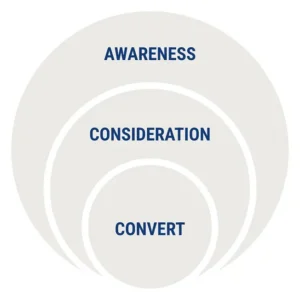 The traditional funnel assumes people move through a fairly predictable progression: first they become aware of you, then they learn about you, then they decide whether you’re worth their attention, and finally they take action.
Real people are messier.
Some visitors already know your organization and need to get somewhere quickly. They might be looking for a donation page, registering for an event, checking your programs, or trying to contact someone.
Others are researchers. They’re comparing organizations, trying to understand an issue, looking for evidence of impact, or figuring out whether your organization aligns with their values. They may visit several times before they’re ready to do anything.
And some are simply browsing. They may have encountered your organization through a social post, a colleague, an event, a news story, or a recommendation and aren’t sure yet what they’re looking for.
Research from Nielsen Norman Group has long shown that online visitors arrive with different levels of intent and different motivations. Some know exactly what they want; others are researching, browsing, or discovering what a site has to offer. Your website is the place where all these journeys collide.
Think Exposure Loop, Not Marketing Funnel
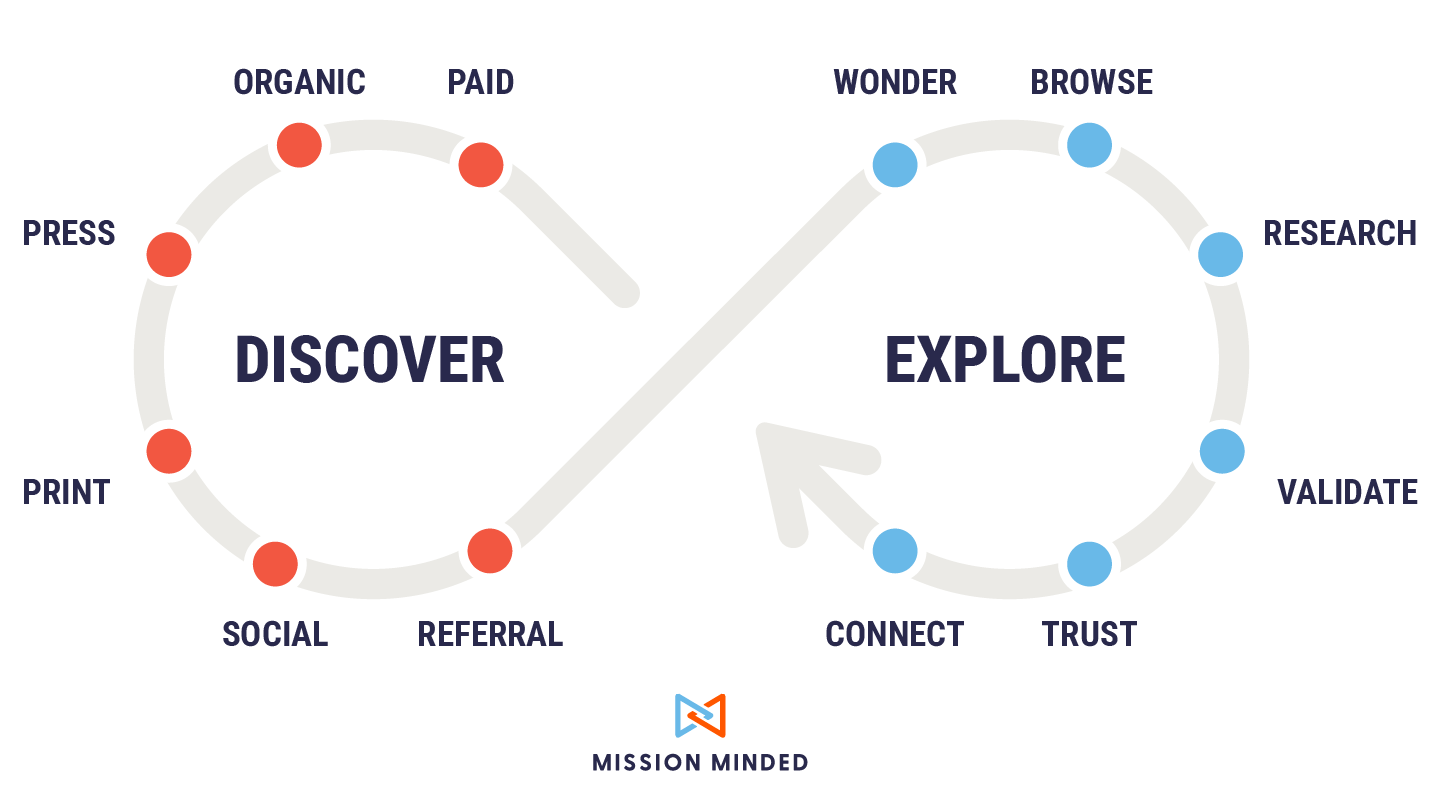
A more useful model for nonprofit marketing is a continuous loop.
People discover you.
They browse.
They learn.
They leave.
They come back.
They research.
They ask questions.
They take action.
They encounter you somewhere else.
Then they return with a deeper understanding of who you are.
And the loop starts again.
There are four types of searches to discover a website:
BRAND: searching for an organization by name
ACTION: ready for the action they want to take
OFFERING: researching for programs or services with a goal
EDUCATION: learning about industry information and answers to questions
When analyzing search data for nonprofits, a common pattern is A LOT of brand and education traffic, but minimal offering and action traffic.
Here are a few ways to think differently to fix this:
- Not every page on your website needs to be wired up in your navigation. This means creating landing pages named and tailored to specific actions your audience wants to take. Contact forms should be high up on the page followed by information on what to expect.
- Sometimes branding every program and offering is missing a key opportunity to use plain language users are using when researching their options. Don’t let brand recognition be a barrier to discovery.
- Webpages often aren’t as specific as search patterns. For example, there may be a lot of organizations that offer the same programs and they’re all competing in search results. Going the extra mile to make multiple versions of those pages that tailor to a unique audience or region provides a more personalized experience and mirrors how people search.
This changes what your marketing needs to do. Instead of asking, “How do we move people down the funnel?”, ask: “What does someone need from us right now and what might they need next?” That is a very different website strategy.
Your Website Has to Meet People Where They Are
A strong website should make sense to someone encountering your organization for the first time and someone who’s been supporting you for years. That means giving different visitors with varying levels of brand understanding need different ways in.
The ready-to-act visitor needs a clear path.
Don’t make someone who already knows you work for it. Make it easy to donate, register, volunteer, contact your team, find an event, or access whatever brought them to your site.
The curious visitor wants to keep browsing.
Someone who arrives through a social post or recommendation may not know enough to act yet. Give them compelling stories, clear explanations, strong visuals, and obvious paths to learn more.
The researcher needs reasons to trust you.
If someone is seriously evaluating your organization, a few paragraphs of mission language won’t cut it. Think of a participant quietly comparing options or a donor deciding whether to make a bigger gift.
They want to understand your approach, your impact, your leadership, your programs, and your perspective. And they want evidence to back it up.
The best websites don’t force everyone through the same journey. When we build websites, we start with the brand goals the organization is trying to establish. Then we design an experience that makes those qualities tangible—building comprehension, trust, and ease of use along the way.
Your website should demonstrate your brand, not just talk about it. Show. Don’t tell.
Rethink the Funnel and Rebuild Your Brand Experience
This is where the old funnel gets particularly misleading. Your website isn’t necessarily where awareness ends and conversion begins. It’s part of the entire marketing ecosystem. Your website needs to be more than a brochure. It needs to be a living, connected experience that supports discovery, exploration, decision-making, and action.
The modern marketing journey isn’t about pushing everyone toward the same action as quickly as possible. It’s about creating enough value that people can keep moving through their own journey with you. Your audiences aren’t moving through a funnel. They’re moving through a relationship with your organization. Your content should make that relationship easier to start, deepen, and continue.
Here are 7 ways for your website to meet the demands of search and also turn that visibility into a useful, engaging experience for the people who find you:
1. Create content that answers the questions people are actually asking.
Adding page specific FAQs or diving deep into a subject with a blog post are great ways to do this.
2. Give first-time visitors a compelling introduction to your organization.
Homepage mastheads that serve as a rotating carousel of everything you have going on are a missed opportunity to pause and introduce who you are and the impact you create.
3. Make deeper information easy for researchers to find.
Only relying on your navigation as a way to browse a site misses key opportunities to invite navigation on a page using plain language or highlighting the benefits as a motivator to click.
4. Build clear pathways to donate, register, volunteer, apply, or connect.
Your website should not be a reflection of your internal organizational structure. Audiences shouldn’t be burdened with understanding departments, divisions, or roles.
5. Use stories, photography, and video to make your work tangible.
Almost everyone has a phone in their pocket and is looking for a full multimedia experience. Can’t show program participant faces for safety and privacy reasons? Hire an artist to create illustrations!
6. Name pages for what people need and not how your industry speaks internally.
Audiences often don’t know the solution by name and are searching based on a problem they want to solve or outcome they want to have.
7. Create a strong brand and point of view that distinguishes your content from what AI can produce.
Say something no one else in your space is saying. If a competitor nonprofit could publish your homepage copy word for word, it’s not doing its job.
So if the journey is no longer linear, what helps people recognize, understand, and remember your organization along the way? Your brand.
Google’s current guidance for generative AI search puts the emphasis somewhere more interesting: unique points of view and non-commodity content that is helpful, reliable, and people-first. Google specifically recommends creating content based on an organization’s own knowledge and experience rather than simply recycling what already exists.
That’s good news for nonprofits with something real to say. The organizations that stand out will be the ones with a clear brand strategy and distinctive creative at the core of everything they put into the world with a web experience flexible enough to meet people wherever and however they choose to engage.


